

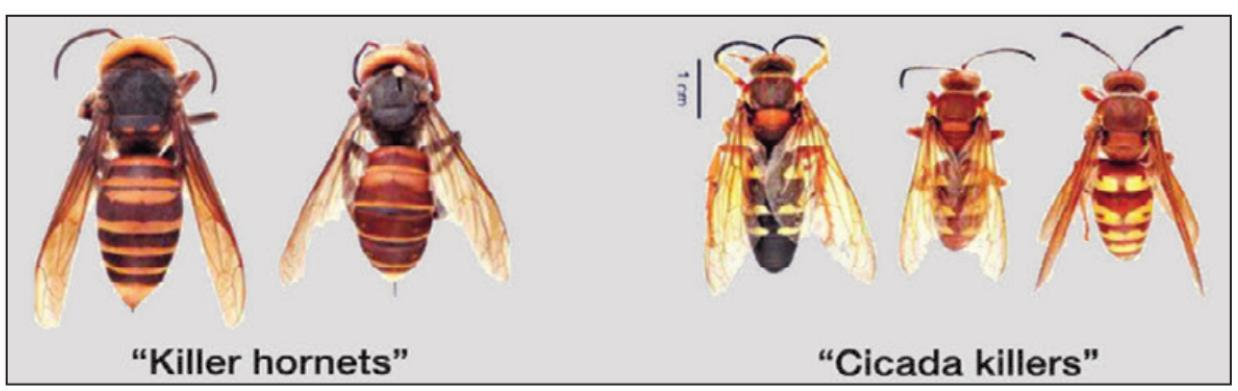
Is that really big buzzing insect flying around your back door one of the feared “Murder Hornets?”
Probably not.
County Agent Floyd Ingram told The Reporter this week a number of county residents have brought him insects they feared might have been the headline-grabbing media sensations which have been the topic of somewhere between conversation and panic for weeks.
“Every single one brought to me was a species called Cicada Killer,” Ingram said.
The “Murder Hornet’s” actual name is the Asian Giant Hornet. It is the world’s largest hornet.
“I’m not going to say there aren’t any in Milam County, or there could never be one in Milam County,” Ingram said. “All I’m saying is I haven’t seen one here.”
GIANTS—He noted the Cicada Killer is similar to the Asian Giant, although not quite as large.
“The ‘Murder Hornet’ is about a half-inch bigger, but they are both really big for flying insects,” Ingram said. “It’s not surprising that if you see a big orange-yellow-black insect flying around you might think it’s one of the Asian Giants.”
The “Murder Hornet” got its nickname due to its penchant for killing other insects with its powerful sting, potent enough to possibly be fatal to a human if attacked by a swarm of the insects.
However, that’s also the case with other stinging insects, especially if the human is allergic to the sting.
There was a similar concern in the 1990s-early 2000s over Africanized Honey Bees which drew the nickname “Killer Bees.”
About 1,000 human deaths were attributed to those insects, inducing a Moody, Texas, man in 2013.
“Killer Bees” rapidly spread across the United States and have essentially merged with, and taken over, many domestic (European) beehives.
CICADA KILLERS—What about the more numerous Cicada Killers?
Are they dangerous? Usually not, “They got their name for a reason,” Ingram said. “They are out after cicadas, those large, buzzing insects you can hear all over about this time of year. Some people call cicadas ‘locusts’.”
Entomologists note the Cicada Killer paralyzes the cicada, takes it underground and lays its eggs on the larger insect. Cicada Killers aren’t aggressive but can sting when threatened.
- Log in or Subscribe to post comments.