

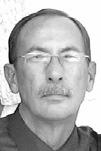
Rev. Dr. John Kinney is Dean of Samuel DeWitt Proctor School of Theology at Virginia Union University. Dr. Kinney was brought up and schooled in Wheeling, West Virginia in the days of segregation, meaning there were no white children at his school. All twelve grades met in the same building but his second grade teacher had just died of pneumonia so his class was ushered into the third grader’s class under Miss Gertrude Dixon.
Gertrude Dixon was the typical school mom: She had this bun on the back of her head and walked around fast, bent over with this stick in her hand. This week she was teaching the times tables and all the class was learning at the third grade level.
She had these pull-down charts with black ink with the times tables that went all around the room; and she would point at you and you would have to say the times tables. She also had two sticks in her hands: one was a pointer and one was a rod; and she would tap the ground with that rod.
And the students didn’t just blandly say their times tables; there was a rhythm, a cadence: “Two times two (bump, bump) is four; three times three (bump, bump) is nine”—and the class would be rocking and bobbing with the rhythm of learning.
Miss Dixon also had charts under the charts, but without the answers, only the equations. She would walk around the room and point to a student and the student had to walk around the room with her and give the answer when she pointed to the equation.
Finally she pointed to John and he made it perfectly all the way to “Twelves times twelve is (bump, bump) one hundred forty- four.” Then, proud as a second grader among third graders, he walked back to his seat with the same rhythm: step, step (bump, bump) step, step.
Miss Dixon said, “Well done, Mr. Kinney. You passed.” John was so excited. He had done his part. Next, Jimmy was called but stumbled on four times four. He said, “Four times four is...oh!...fifteen;” and John laughed out loud.
Miss Dixon hit the wall with that stick—BLAM! She took Jimmy’s hand and walked back to John’s desk, stood over him and said, “Mr. Kinney, I told you, you did well and you passed. But you just let me know you don’t have what it takes to pass. Mr. Kinney, hold out your hand.”
He just knew she was going to give him a lick with the rod, but what she did— she put Jimmy’s hand in his hand and said, “Mr. Kinney, until Mr. Smith passes, you don’t pass.”
Dr. Kinney recalls, “I lost my recess time and my play time, and had to stay after school tutoring a child that had already failed the third grade, because I laughed at him because he was struggling. And the next time he got up there, I wasn’t laughing; I was praying, ‘You help him, Lord! You help him!’
“I learned a lesson in the second grade: you cannot succeed when you are laughing at someone else who is failing; and you do not know life if you can laugh at somebody’s else’s death.”
In the first epistle Paul ever penned, that to the Thessalonians, he wrote: “Encourage one another and build up each other.” Your brothers and sisters who are struggling don’t need the ridicule of your laughter; they need your support and assistance. Now, for Jesus sake and theirs and yours, get out into life and help one another (bump, bump).
- Log in or Subscribe to post comments.