

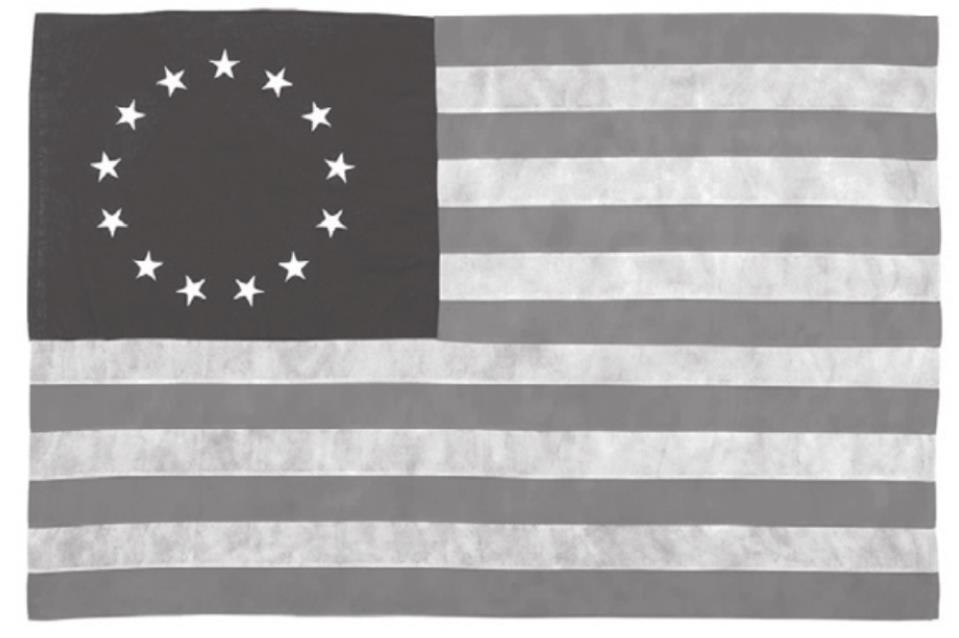
Next Monday, June 14, is Flag Day which is the day the Second Continental Congress passed a resolution stating that “the flag of the United States be 13 stripes, alternate red and white,” and that “the union be 13 stars, white in a blue field, representing a new constellation.”
The reason they did this was because when the Revolutionary war broke out in 1775 there were many different militias fighting under their own flags. President George Washington thought they should fight under the same flag and thus the stars and stripes were born.
Over 100 years later, in 1916, President Woodrow Wilson marked the anniversary of that decree by officially establishing June 14 as Flag Day. As you celebrate the anniversary of the Stars and Stripes, here are some fast facts about “Old Glory.”
It is widely believed that Betsy Ross, who assisted the Revolutionary War effort by repairing uniforms and sewing tents, made and helped design the first American flag. However, there is no historical evidence that she contributed to Old Glory’s creation. It was not until her grandson William Canby held an 1870 press conference to tell the story that the American public learned of her possible role.
The lyrics of “The Star-Spangled Banner,” America’s national anthem since 1931, are taken from a patriotic poem written by Francis Scott Key after he witnessed the Battle of Fort McHenry during the War of 1812. His words were set to the tune of “To Anacreon in Heaven,” a popular British drinking song.
In the 1950s, when it seemed certain that Alaska would be admitted to the Union, designers began retooling the American flag to add a 49th star to the existing 48. Meanwhile, a 17-year-old Ohio student named Bob Heft borrowed his mother’s sewing machine, disassembled his family’s 48-star flag and stitched on 50 stars in a proportional pattern. He handed in his creation to his history teacher for a class project, explaining that he expected Hawaii would soon achieve statehood as well.
Heft also sent the flag to his congressman, Walter Moeller, who presented it to President Eisenhower after both new states joined the Union. Eisenhower selected Heft’s design, and on July 4, 1960, the president and the high school student stood together as the 50-star flag was raised for the first time. Heft’s teacher promptly changed his grade from a B- to an A.
The rules for displaying the flag are called the Flag Code.
The Flag Code stipulates that the Stars and Stripes should not be used as apparel, bedding or drapery.
Flag Code etiquette calls for American flags to be illuminated by sunlight or another light source while on display.
When the flags of cities, states, localities or groups are flown on the same staff as the American flag, Old Glory should always be at the peak. When flags of two or more nations are displayed, they should be of equivalent size and flown from separate staffs of the same height
The Flag Code strictly prohibits adding an insignia, drawing or other markings to the Stars and Stripes. Some politicians have been known to defy this regulation by signing copies of the U.S. flag for their supporters.
Happy Flag Day to all. —K.W.C.
- Log in or Subscribe to post comments.