


Body
The meaning and history of the word ‘Xmas’
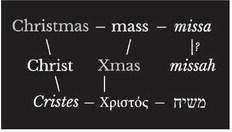
“Xmas” is a widely recognized abbreviation for the word “Christmas.” Contrary to popular belief, the use of “Xmas” is not an attempt to secularize or commercialize the holiday. Rather, its origins are deeply rooted in the Christian tradition, dating back to ancient Greek and Latin languages.
The use of “Xmas” as an abbreviation for “Christmas” has an interesting history that spans centuries and cultures. Let’s dive deeper into its linguistic roots, its journey across the ages, and its signifi cance in contemporary society.
‘X’ from Greek alphabet
The l e t t e r “ X” i n “Xmas” is derived from the Greek letter “Chi,” which is the first letter of the Greek word “Χριστός” (“Chr istós”), meaning “Christ” or “Anointed One.” This abbreviation can be traced back to the early Christian era, when Greek was the dominant language of the Eastern Mediterranean world. The word “mas” is an abbreviation of the Latin word “missa,” which means “mass or Eucharist,” a Christian sacrament commemorating the Last Supper of Jesus Christ.
The abbreviation of Christ’s name using the letter “X’” can be traced back to the early Christian era, when the Greek language played a significant role in the development of Christian theology. The New Testament, for example, was initially written in Greek, and early Christian scholars often relied on Greek texts to understand and interpret the Bible.
One of these scholars was Saint Jerome (c. 347420), who translated the Bible into Latin, creating the Vulgate Bible, the official Latin version of the Catholic Church for over a millennium.
In his writings, Jerome frequently used the abbreviation “XP” (from the Greek letters “Chi” and “Rho”) as a shorthand for “Christ.” This monogram, known as the “Chi-Rho,” became a widely recognized Christian symbol and was often used in manuscripts and inscriptions.
Early Christians using ‘Xmas’
The combination of these two abbreviations—“ X” for “Christ” and “mas” for “mass”—forms the word “Xmas,” symbolizing the celebration of the birth of Jesus Christ. This shorthand was used by early Christians to discreetly communicate their faith in times of persecution, as well as to save space when writing on costly materials such as parchment or vellum.
Renaissance Use of ‘Xmas’
In the 16th century, the word “Xmas” became more widely used in Europe. The abbreviation was adopted by religious scholars and clergy, who used it in their writings and correspondence. It was considered an acceptable shorthand for Christmas, without any negative connotations or intent to diminish the importance of the holiday.
The use of “Xmas” as an abbreviation for Christmas began to gain wider acceptance during the Renaissance, when the printing press was invented, and books became more widely available. The abbreviation was used to save space and ink on the printed page, and it was considered a convenient shorthand for the longer word.
“Xmas” was employed by various scholars and theologians, including the influential English reformer and Bible translator, William Tyndale, in the early 16th century.
18th and 19th century use of ‘Xmas’ In the 18th and 19th centuries, “Xmas” continued to be used in both religious and secular contexts. As literacy rates increased and letter-writing became a popular means of communication, people embraced the abbreviation as a convenient way to refer to the holiday in their correspondence.
The Oxford English Dictionary, first published in the late 19th century, included “Xmas” as an accepted abbreviation for “Christmas.”
Modern ‘Xmas’ In mo de r n t ime s , “Xmas” has become a common abbrev iation for Christmas, especially in informal contexts and commercial settings. Some people may perceive the use of “Xmas” as an attempt to remove the religious aspects of the holiday or to secularize the celebration. However, the historical origins of the word demonstrate that it is rooted in religious tradition and has been used by Christians for centuries as a respectful abbreviation for Christmas.
Today, “Xmas” is still used in various settings, from holiday cards and text messages to advertising and commercial displays.
While it is true that some people may perceive the use of “Xmas” as an attempt to downplay the religious aspect of the holiday, it is essential to remember that the abbreviation’s origins are deeply rooted in Christian tradition. By understanding its history and linguistic roots, we can appreciate the word “Xmas” as a reverent shorthand for “Christmas,” a testament to the adaptability of language and the enduring significance of the holiday across cultures and time.
The use of “Xmas” instead of “Christmas” r ema ins a va l id and respectful way to refer to the celebration of the birth of Jesus Christ.
From christmasphere.com
- Log in or Subscribe to post comments.