



Editor’s note: The late Susie Sansom Piper, authored Black History Series for The Reporter over a 42-year period. This year’s series is being written by her granddaughter Tamara Powell.
Roderick Wesley was the middle child of the nine children born to Annie Bell Page and Charles C. Wesley. Roderick was born Dec. 24. One sister died at birth leaving seven boys and one girl in the family. His parents were hard-working Rockdale citizens who attended and graduated from the segregated Aycock High School.
Annie Bell was a great basketball player on the Aycock girls’ basketball team. After graduation, she finished some college courses at Paul Quinn College in the 1950s. After pursuing educational courses, she worked in nursing homes in Rockdale. Charles worked at the IGC plant in Rockdale.
I remember them both as calm and generous spirits. They lived on E. Sixth Street. They were a tightknit, fun-loving family. They worked hard and provided everything that they needed, and “some things they wanted,” Roderick said.
They instilled Christian values and took the children to church on Sundays. Often the family would go to Sunday school, morning service, and then evening services. Roderick recalled the one Sunday, he didn’t want to go to church because it was an all-day affair. So his mother gave him a choice: Sunday school or morning service. Roderick thought picking Sunday school was the best choice because he would have the rest of his day free. He later realized that his mother tricked him. She knew that he would get more out of Sunday school. In Sunday school he learned with other children, did activities and time passed quickly.
The children were reared with a work ethic. Roderick said that he was rolling hay bales at the age of 8 or 9. Since he was not strong enough to lift them, he would roll the bales, and his brothers would load them on the trucks. When he got older, he would drive the truck or lift bales, too. He said that they also picked pecans and did other odd jobs. As they got older, his Dad would pay them so that they could learn the value of money. They would use their money to buy school clothes while their parents provided other needs.
The eastside community was a village that helped rear children. Everyone knew that if you were doing something wrong, the adults on that side of town could and would correct you.
Roderick remembers one day he was throwing rocks in the street, he broke the window of a passing car. The driver went to the church and found his father, resulting in Roderick getting punished when his dad came home.
Life lessons were also taught just by listening to neighbors and community adults. He recalls a time when the black players on the Rockdale High School football team felt mistreated. They planned to quit the team. Roderick’s father, Mr. Locklin and Rev. Brooks called the boys together and encouraged them to keep playing. These men and others in the black community, by their influence and examples, taught young people lessons on dealing with controversy and adversity.
Roderick and all his siblings were active in high school sports. His parents never missed an event.
The family balanced work with fun. His parents played on a community softball team. Roderick’s mom and older sister, Barbara, played on the team and his father coached. It was often a fun community event to watch Saturday afternoons.
After graduating from RHS in 1981, Roderick worked at an oil seed mill in Thorndale for about a year. There he met a man that changed the course of his life. He was a policeman from Taylor moonlighting at the oil seed mill. He would work his shift in Taylor and then go to the seed mill to work another shift. The man encouraged Roderick to apply at the police station in Taylor. He had never considered law enforcement, but talking with the man for a month or so, Roderick decided he would try it.
The Taylor chief wanted younger guys that he could mold the way he wanted them to be. Roderick was hired at the Taylor Police Department on April 1, 1982. He was 19 years old. He laughed and said that the older men would always tease him because the laws, at the time, allowed 19-year-olds to buy guns, but you had to be 21 to buy bullets.
In 1984, his father died. It was a hard loss to bear, but Roderick carried on.
After five years on the Taylor police force, he decided to move to a larger precinct. He began working in Austin in 1987.
In February 1988, he married Dianna Krieg. They had two children, Anthony and Briane.
His calm and respectful nature, his communication skills and his ability to “read” people served to position him for success. Initially, he worked on patrol and the traffic unit. Later, Roderick was picked to be one of 14 officers in a special patrol unit. Next, he was selected along with six officers out of the 14 and one sergeant to do “license and weight inspection,” regulating large commercial vehicles.
Roderick believes that the values instilled by his parents were the key to his success and that of his siblings and their children. His parents taught them to “treat people the way you want to be treated, and don’t hate anyone but love everyone.”
As an officer, Roderick said that there was cultural diversity training in the precinct about how to deal with people.
“It is not usually necessary to force your will or exert your authority, although there are times when you have no choice. As an officer, being nice to people and being able to communicate to resolve conflicts or issues, if the situation and timing permitted, was important for deescalation,” said Roderick.
Roderick said he sometimes experienced racism.
He felt that in some incidents they did not see his uniform, they just saw the color of his skin and treated him in a disrespectful manner. Some black people felt that just because they were black and he was a black officer, he should give them special treatment.
But he remained ethical and fair when dealing with all. Roderick said that has arrested both black and white people who called him names, “Uncle Tom, the n-word” and other derogatory terms.
People who were drunk were often the culprits.
“If you are a mean person, you will just be worse when you drink,” he said.
Roderick recalled that while in a store one day, he was in uniform with his partner. A white woman in her 70s left her cart at the end of an aisle with her purse in it. He pushed the cart to her and said that she should be more careful.
She looked at him and snatched her purse, didn’t say thank you, just offered a nasty look, he said.
At that moment, he felt that all she saw was a person that was “big and black,” not law enforcement. Another incident occurred at the hospital. A woman similar to the woman in the store, was cowering down and looking fearful in the elevator where Roderick and his partner were waiting to change floors. Again, they were in full uniform. The woman was clutching her purse. Roderick told her “Ma’am, we are just police officers, we are not going to do anything to you.”
She calmed down and thanked them for the job that they do.
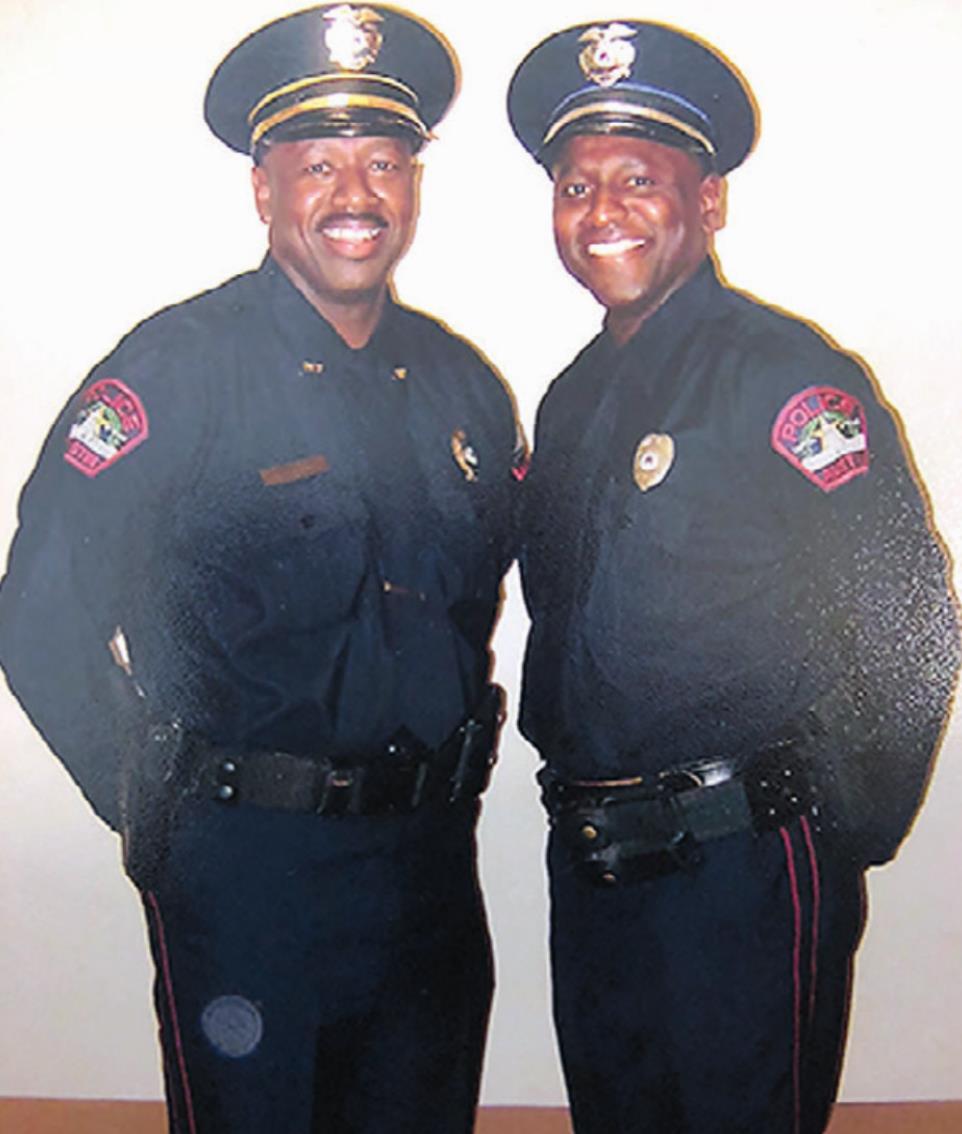
In December 2001, Roderick was promoted to detective. There, he worked in child abuse, narcotics and the organized crime division. Roderick moved to the repeat offenders Career Criminal Unit. When the unit was disbanded, he decided to go back into mid-level narcotics. Roderick became part of the human-trafficking team. He remained there for several years before going back into highway enforcement. He retired with 33 years in law enforcement in January 2015.
As for his family life, Roderick has passed on the values he learned to his children. His son, Anthony received a football scholarship to Baylor University. Daughter, Bree, received a softball scholarship to McClennan Junior College and, after receiving her associate degree, graduated with a bachelor’s degree from UTSA. Both children are now married and have families. They both work for the Austin PD. Anthony as an officer, and Bree in administration.
Roderick lost his beloved mother in 1997.
Although his parents are gone, their memory and values live on in their eight remaining children. All hard-working, appreciating the value of a dollar and knowing that you are not entitled to anything that you have not earned.
The soul of the black family is in the homes and community. Roderick and his brother, Darin, became police officers. Darin now works for code enforcement in Austin. Sister, Barbara, is the Rockdale Federal Credit Union branch manager in Thorndale, and brother Lawrence is a retired Austin fireman. Leonard retired as a security guard in Las Vegas. Anthony worked various jobs and is now disabled. Dexter is a football coach in Houston. Cedric, the youngest, is teaching school in Connecticut. The grandchildren that are working age, have also been successful in their chosen professions.
Since retiring, Roderick is enjoying his life with his grandchildren, exercising, fishing, traveling and hiking. He serves as a deacon at New Light Ebenezer Baptist Church.
Roderick has coined a slogan from one of the community elders, Mr. Locklin. He decided he is going to constantly move around in retirement and “wear out vs. rust out.”
- Log in or Subscribe to post comments.