

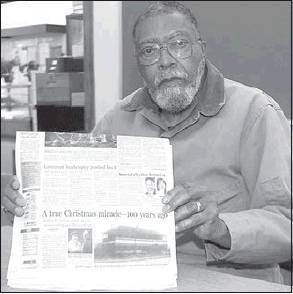
This is the fi nal of a two-part series on Dr. Leroy Swift. Part one was published last week.
Swift began his law enforcement career as a patrolman at the Kansas City Missouri Police Department after serving in the U.S. Army as a military police officer and a high speed (Morse Code) radio operator. He was one of 30 black officers of a 1,300-member force in 1958.
He said it was a segregated department where blacks were not allowed to drive patrol cars or motorcycles.
“When I first came on in 1958, the Kansas City Police Department was run by some rather paternalistic bigots, racists who didn’t know they were racists,” Swift told The Kansas City Times in 1985.
The lowest point in his career came in 1965 when he was suspended by his commander without pay for made up infractions like wearing a pair of dark colored shoes rather than black and not being in uniform, he said.
This was during the time he wanted to get a higher education, so he could be promoted in the ranks.
He contemplated coming back to Texas to take over his father’s trucking business but his anger kept him in Kansas City, he said.
“I said hell no, I’m going to fight this,” he said. “I figured I can be offended, get mad and quit, but then it dawned on me that God raises us up in his own time for his purpose.”
Swift’s superiors considered him an activist because of his outspokenness.
“When he first started working for me, he was young. He was not the type to do something just because someone told him to,” Sgt. William Bumpus, who was Swift’s first black sergeant, told The Kansas City Times. “But that was at a time when you were not supposed to question some of these things, kind of the way it was in the Army.”
“Minorities were either put in the category of being militant or submissive,” Bumpus said. “I never felt Swift was militant, but given those two categories he was.”
Swift said: “I always would speak my piece.”
He earned a bachelor of science degree from the University of Missouri-Kansas City in administration of justice and master of science degree from Central Missouri State University in criminal justice administration.
“It was not lost on me that my father was always busy with the community. Always very involved in black law enforcement in the city. He was always engaged in seeking justice and equity in law enforcement in Kansas City,” Dr. Swift’s daughter, Darrylyn, recalled. “Because of this people respected and looked up to him.”
Jazz
Swift met many musical celebrities during his tenure on the force. In the ‘70s Kansas City was undergoing an urban renewal project. The city tried to create a jazz enclave along the Missouri River’s City Market neighborhood.
A mob gang war that led to three clubs being bombed was the demise of the mafia and the entertainment center.
“His beat was 18th Street and Vine. It was the jazz district in Kansas City,” said Darrylyn. “He was one of the few black law enforcement officers at the time and everyone knew him. He was known around town and everyone embraced him.”
He knew Dick Gregory, Sam Cooke, Ella Fitzgerald and Count Basie because of his line of work.
Swift said he’d never forget the night Ella Fitzgerald sang to him.
“I went to pick her up one day,” Swift said. “I had borrowed a police sedan, plain clothes car and she started singing one of her songs to me, personally. She was a sweetheart. She was in the car and I was driving. She was very nice. She asked me questions. Was I married? Then she started thinking out loud and I heard that sweet voice. I thought I’d died and gone to heaven.”
Darrylyn recalled that the American gospel singer Dottie Peoples called Swift on his birthday to sing him “Happy Birthday.”
Whenever Count Basie visited Kansas City, “We would go sit up with him at night. He had trouble going to sleep,” Swift said. “Me and another officer would talk with him for three or four hours until he got sleepy. We put him to bed at night.”
Texas
After retirement from the Kansas City Police Department in 1985, Swift moved to Texas. He served 11 years as the chief of the Austin Texas Park Police and retired for the second time in 1996.
After retirement, Swift attended the Institute for Teaching God’s Word in Rockdale in 2002 and served as the senior deacon of the Mount Tabor Baptist Church in Gause. He earned a master of arts degree in Biblical Studies from Tryannus University of Biblical Studies. He also received a doctor of ministry degree in pastoral counseling from Tryannus University.
In August 2006, Dr. Swift was called to pastor the church he attended as a child, Mount Tabor Baptist Church in Gause.
He also served as the provost for the New Jerusalem School of Ministry for the 2005-2006 school year, and serves on the staff of the Institute for Teaching God’s Word Seminary.
In December, 2008, Dr. Swift was awarded a doctor of divinity degree by the Institute for Teaching God’s Word Theological Seminary
“I’m proud of what he accomplished from a career perspective. He has metamorphosed into the man he is today – living Christian values. That is legacy he leaves. This is why he shares his sermons,” Darrylyn said.
- Log in or Subscribe to post comments.