

Gee, has a 146-year-old mystery finally been solved?
Thanks to a church history in a 100-year-old Rockdale Reporter, a different story on the naming of our town has emerged.
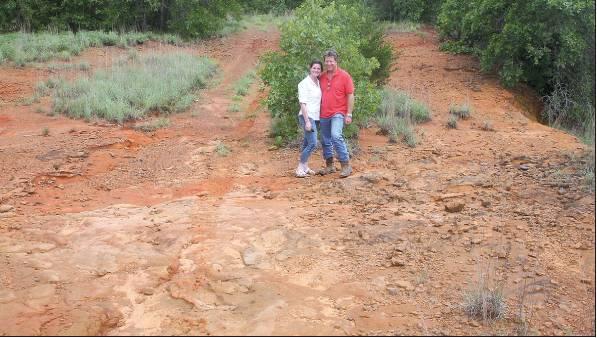
The Reporter toured local landmark Gee Mountain with an owner last week after fresh evidence—if a story published in 1919 can be “fresh”—emerged that it might be the rock for which the town was named.
The “mountain” has been owned by the Ernest Noack Family for 91 years. Alan and Natalie Noack conducted the tour to the top of the iron ore outcropping, sharing many memories of the locally-known landmark southeast of town.
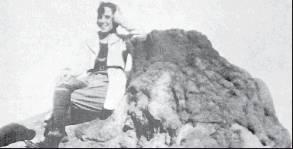
MISS GUSSIE—For decades the generally-accepted naming story has been that Mrs. B. F. Ackerman, whose husband sold some of the lots on which the new town was built in 1873-74, named Rockdale for a 10-foot high boulder she observed while riding a stagecoach from Cameron.
There have been several searches for “the rock” through the decades.
But The Reporter’s 100 Years Ago column last week, uncovered a history of First Baptist Church, written by Miss Gussie Rowlett.
Her grandfather, Rev. B. B. Baxter helped found that church and Rev. Baxter was on the first I&GN train to reach Rockdale.
She relates a much different rock story. According to “Miss Gussie,” the railroad had already named several non-existent towns on a map as the tracks built westward from Palestine. And one of them was “Rockdale.”
She said the name came from “a large one (rock) nearby and many small ones about five miles south of town.”
That would predate the Ackerman story. Also, Mrs. Ackerman came to town from the north. The rock(s) cited by Miss Gussie were southeast of town.
FAULT ZONE—That information was also included in a column in last week’s Reporter.
Longtime Reporter reader Bruce Holliman of San Antonio read it and replied, saying “a big rock five miles southeast of Rockdale” is a perfect description of Gee Mountain.
Indeed. The Reporter contacted the Noack Family and discovered Ernest Noack purchased the land in 1928 and passed it on to son Leon. Now it is owned by the third generation of Noacks.
Ernest Noack died in 1956 and Leon Noack in 2015.
Gee Mountain is a part of the Talco-Mexia Fault Zone, a fracture where two plates of rock slide past each other.
Its most prominent outcroppings in Milam County are Gee Mountain and Sugarloaf Mountain near Gause.
There’s a marked difference between the land at the base of Gee Mountain and the mountain—it’s more like a bluff—itself.
The summit ridge is composed of iron ore. It’s a dusky red color with many rocks eroded from the top and sides.
“At one point during the Great Depression the Works Progress Association mined iron ore from near the summit and used it to help build what became FM 908,” Alan Noack said.
HISTORY—Gee Mountain—named for an early settler named Gee, not the letter “G”—has a long history.
Noack said there are traces of Native American life in the area and wagon wheel tracks are still visible.
And, of course, treasure hunters have flocked to the area over past decades, as has been the case for just about every high point in Texas.
There’s a legend that either 40 or 21 jacks (male donkeys) laden with either gold or silver disappeared in Texas years ago and their cargo has never been found.
Noack said treasure hunters have visited the area of Gee Mountain, failed to find anything and even blew up some of the rocks.
“My family didn’t like that very much,” he said.
Even though it’s on private property, the mountain also has an unofficial history over the decades, as a popular destination for sightseers. There are names carved into some of the rocks.
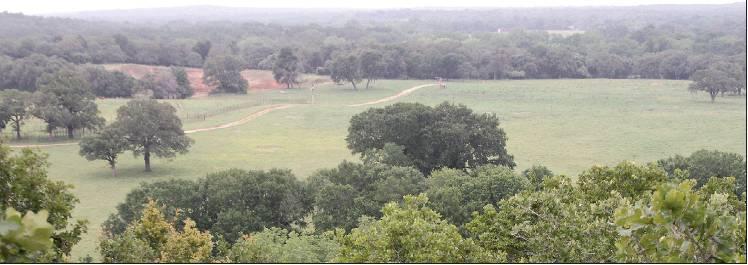
To the Noacks, the mountain has been a much-loved site for family campouts, picnics and gatherings. It obviously (see photo above) provides one of Milam County’s best views.
TO ROCK, OR NOT TO ROCK?—But the question of the day, if not the century, is does Gee Mountain fulfill the criteria for placing Rockdale on that railroad map 146 years ago, leading to our town getting its name?
It’s definitely in the right place, exactly where Miss Gussie said the “naming rock” was located.
Visiting it on a May afternoon just after three weeks of wet weather, there’s not much “rock” visible from below in all the vegetation.
But Rockdale wasn’t named in 2019, it was named in 1873. It’s not hard to imagine, before a century and a half of tree growth, a massive red ridge of rock looking more like it belonged in the New Mexico desert than in Central Texas.
“We can even see growth in the trees just over the last few years,” Noack said. “The views from the top, and of the top, are much more obscured than it used to be.”
Could Gee Mountain have caused some railroad advance surveyor to look across the rolling prairie and pencil in “Rockdale” for a then non-existent town?
In truth, we probably will never know.
Just as we will probably never know if Mrs. Ackerman did much the same several miles to the south.
- Log in or Subscribe to post comments.