

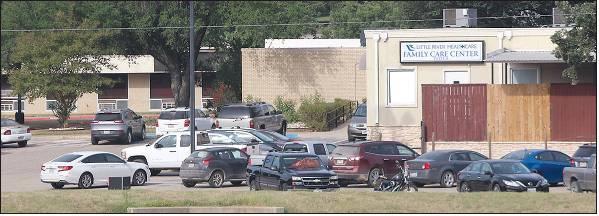
For the second time in 15 years Rockdale’s hospital is seeking bankruptcy protection while it works out a restructuring plan to pay its creditors.
Little River Healthcare (LRHC), which is based in Rockdale and operates the 44-year-old former Richards Memorial Hospital, filed for Chapter 11 Bankruptcy last week in Texas Western Bankruptcy Court.
Chapter 11 Bankruptcy does not necessarily mean a business intends to close. It is primarily a vehicle to arrange a plan to pay off creditors while remaining under court protection from those creditors.
“Medical facilities will continue to operate with no changes to patient care,” Andrea Cunha, LRHC general counsel, said.
There have been considerable layoffs but Cunha, who is serving as the company’s only official spokesperson, would not release the numbers, saying she was “not authorized” to do so.
She said no further layoffs are planned.
The hospital went through a Chapter 9 Bankruptcy 15 years ago, emerging from that protection in 2003.
For the past 29 years the facility has endured periodic financial crises and is believed to have come within days of closing its doors at least once in 2010.
OPEN—LRHC operates the Rockdale and Cameron hospitals and other facilities throughout Central Texas. Cunha said the company intends for all of them to remain open for business and “continue to provide world class medical services without any interruption in patient care.”
According to court documents LRHC and its affiliates listed nearly 600 employees and an associated physician practice employs 63 doctors.
Cunha said the affiliate, which employs most of its physicians, did not file for bankruptcy.
“As part of the company’s restructuring efforts, some operational and administrative changes have already been made,” Cunha said. “These changes have been designed to allow the company to resume profitability.”
CREDITORS—The court documents list the largest creditor of LRHC as American Express, at $3.5 million, followed by lab test company True Health ($3.4 million) and the Cerner Corporation ($1.4 million).
Those court documents also indicate LRHC and its associates owe more than $1 million in unpaid wages, more than $500,000 to independent contractors and hundreds of thousands for employee expenses, benefi t plans.
LRHC attorney Morris Weiss with the Austin legal firm Waller, Landzen, Dorth & Davis has already had one success in the early legal maneuvering.
Typically, the law allows 14 days from the bankruptcy filing until the company must file financial reports with the court, including its assets, liabilities, income and expenditures.
But Weiss was able to obtain a delay until Sept 22, citing the case’s complexity.
One month before the bankruptcy filing, LRHC entered into an operating agreement with Healthcare Managing Partners and two managing directors of that company are expected to serve as chief restructuring officer and chief financial officer under the bankruptcy plan.
LONG SAGA—Financial troubles at the hospital, which opened in December, 1974, are not recent occurrences.
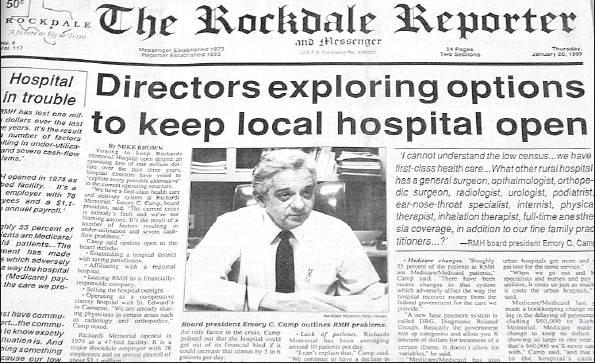
In January, 1989, Emory C. Camp, hospital board president, announced Richards Memorial had lost $1-million over the past three years and was in imminent danger of closing.
What happened next was a remarkable outpouring of community and corporate support.
Spurred by three $50,000 matching grants from the Alcoa Foundation, the community rallied behind RMH with everything from bake sales and selling farm animals to 5K runs and a pro wrestling card.
Over $400,000 was raised and the hospital stayed open.
But six years later it was in crisis again. Directors said the facility was underutilized and needed a new approach to stay open.
Again the community rallied, creating a hospital district with the authority to levy a property tax.
Directors set a rate of 48 cents then scaled it down and finally eliminated it altogether as finances improved.
But before that could happen the hospital went into Chapter 11 Bankruptcy, emerging in June, 2003.
CLOSE CALL—The hospital merged with a private company, Blackhawk Health Care in 2006.
But by the summer of 2010 another crisis loomed.
Blackhawk, cut the hospital staff by 15 to 20 percent as it struggled financially.
In late November, Black-hawk closed its Lakeside Hospital in Bastrop and officials in Rockdale were worried RMH was next, possibly in as soon as five days.
Emergency meetings followed and a new buyer was found. The hospital stayed open.
The LRHC era followed and for several years there was expansion into other markets with the company headquartered in Rockdale.
LRHC even announced ambitious plans to merge its Rockdale clinics and place them in the former H-E-B building at WayMar Plaza.
Some work was even done on that building, but it has continued to sit vacant.
And now there’s another chapter being written in the saga.
- Log in or Subscribe to post comments.