

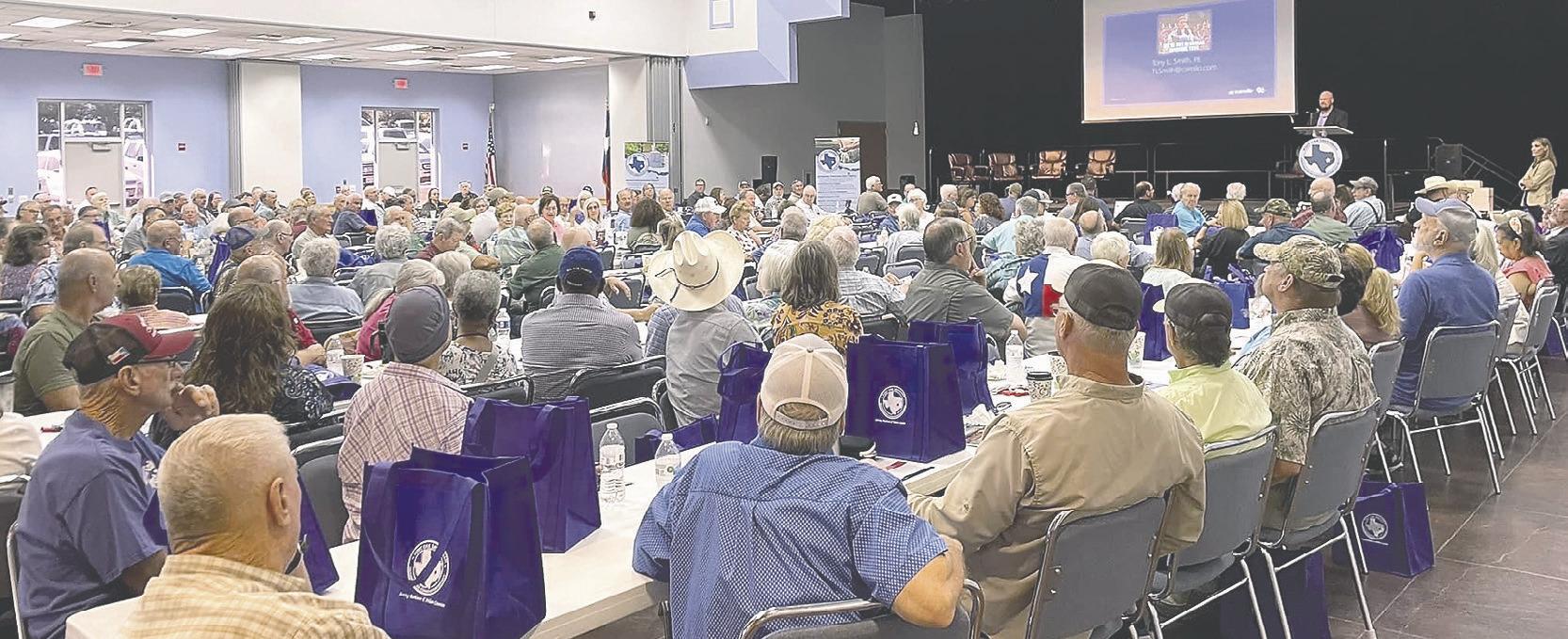
Groundwater experts came to the Caldwell Civic Center on Aug. 17 to speak at the ninth annual Milam and Burleson Counties Groundwater Summit. About 300 people attended the summit this year.
Leah Martinsson, Executive Director of the Texas Alliance of Groundwater Districts, served as the Master of Ceremonies. Martinsson opened the event with an informative address to all attendees.
The first speaker, Tony Smith, an engineer with Carollo Engineers and project manager for the Brazos G Regional Water Planning Group, shared information about the process of Water Planning in the State of Texas.
The second panel spoke on the Vista Ridge Project (piping water to San Antonio) and discussed the effects and impacts of the project and how property rights affect the local Groundwater Conservation District’s (GCD’s) ability to regulate.
Charles Porter, an expert in water rights, discussed how groundwater is an incredibly valuable resource and how water is going to continue to be moved around the state as population centers grow around the state.
Moderator John Dupnik, Texas Water Development Board, posed the question, “Can a groundwater district say no?” This spurred a lively conversation among the panelists.
Gary Westbrook, POSGCD general manager, answered the question this way, “If an applicant does not have enough water rights, they can be told no. Otherwise a GCD can’t say no, but they can say not that much and not for that long.”
Some people in Milam and Burleson County wish the GCD could say no.
Bobby Bazan, Executive Director of Texas Ground Water Association, explained the importance of the association which is made up of Texas well drillers and members of the Texas Water Well industry. Much of their support to their members comes in the form of education programs for water well drillers to make sure they take good care of the asset of groundwater.
During the lunch break, POSGCD Board President Ward Roddam and Westbrook hosted a presentation of awards to retiring board member Steven Wise for his nine years of dedicated service. They also presented appreciation awards to two staff members, Bobby Bazan, who has gone on to be the executive director of Texas Ground Water Association after 10 years of service to the district and Doug Box, education coordinator, who is retiring after five years with the district.
Roddam and Westbrook gave the “State of the District” presentation and introduced the staff and board of POSGCD.
The Honorable Milam County Judge Bill Whitmire welcomed attendees back to the summit after lunch. Judge Whitmire pointed out that this summit is one of the largest in recent years and thanked the attendees for their interest. He talked about how extensive POSGCD’s website is and that people should take advantage of it. He encouraged residents to become more involved with their state, local and county officials.
“We need to all realize the importance of water as it pertains to the future of our district,” Whitmire said.
Robby Cook, former State Representative District 17, authored and worked on many of the important water bills for the Texas Legislature. Those bills included how Desired Future Conditions (DFC) are used in the Texas Water Plan.
The three speakers of the next panel gave an update on the bills at the 88th Legislative Session. Cook of Riceland Consulting gave some historical background on how GCDs, being political subdivisions of the state, were formed and how GCDs manage groundwater. Cook pointed out how there is likely to be a change in water legislation with Representative Tracy King, Chairman of the Natural Resource Committee, retiring. Chairman King is known as one of the fairest advocates for Texas Water law. Also retiring is Representative Four Price.
Leah Martinsson explained how the 92 GCDs work together to manage the groundwater in the state. Each GCD is different because the aquifers and water needs for each GCD are different. All of the GCDs in the 16 GMAs work together as a part of the process to develop the DFCs for the State Water Plan.
Sarah Kirkle, director of policy and legislative affairs for Texas Water Conservation Association, talked about several bills including Senate Bill 156 that did not pass. This bill requires attorney fees to be paid by the district if it loses but if the GCD wins in court, the attorney fees would be paid to the district.
District staff members POSGCD Water Resource Specialist Gregory Perry and POSGCD Compliance Specialist Michael Redman explained how the Monitoring Well Network is necessary to get better science so that Milm and Burleson Counties have good management policies. Perry talked about the GWAP program and how the district has spent over $1,000,000 on assisting landowners with wells that have been affected by regional pumping.
Jaclyn Wise, Extension Associate Texas Water Resource Institute, gave some information on the Texas A&M AgriLife programs that the district offers free for residents of Milam and Burleson Counties. She introduced several other Texas A&M AgriLife programs, including the Big Elm Creek Watershed program, the Little River Monitoring program and the David Creek monitoring Project.
Joel Pigg from Texas Well Owners Network gave an informative program on water quality and explained the results of the water testing program POSGCD provided to local landowners this year, free of charge. Sixty-nine people participated in this year’s water testing.
Speakers’ presentation slides and videos of each program can be found on the POSGCD website at posgcd.org/groundwater-summit/. Videos of the presentation will be available soon.
- Log in or Subscribe to post comments.