

One of the most fabled Native American settlements attributed to Texas is a fable no more.
I t was real and it was located in what is now eastern Milam County, at least so far as Texas is concerned
The Rancheria Grande Archaeological District was approved earlier this month by the Texas Historical commission’s Board of Review as it met in Brownsville.
That designation will be formally considered by the National Park S er-vice later this year.
ntil recent decades the Rancheria Grande—a gathering of 22 tribes and one of the largest “cities” in the 1700s in what was to become Texas—was a topic of debate.
That debate has been resolved, it was located near Gause and now that designation is official.
D E L E G A TI O N — There has been extensive archaeological work done at the site by S ergio and Melinda I ruegas of GTI Environmental in connection with the El Camino Real de los Tejas National Historic Trail effort.
The Milam County Historical Commission, which is heavily involved in the effort, nominated the site to become an archaeological district and that designation was okayed by the state commission.
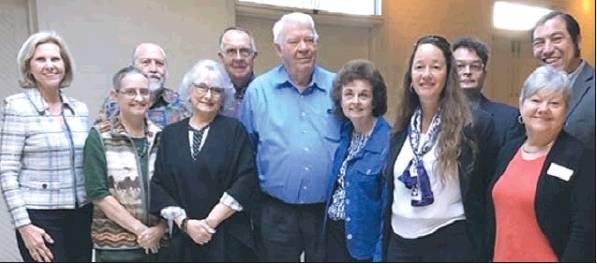
A delegation composed of historians and land owners attended the Brownsville meeting.
They included historical commission members Geri Burnett and Lynn Young, the I ruegases, Dr. S teven Gonzales, executive director of the El Camino Real de los Tejas National Historical Trail, and land owners Gene and Elaine Baumann, Mike and Joyce Conner and Jerald and Joan ise.
The nomination was assured by a $50,000 grant from the National Park service.
HISTORY—The Rancheria Grande was first mentioned in historical documents in 1691 as the location of the meeting of 22 I ndian Nations.
The nations gathered in what might be called a giant village amid the rich Brazos River bottomlands.
During the 1700s, the Rancheria was handy to the old I ndian trails that the S panish repurposed as El Camino Real.
The primary indigenous group, whose members likely gathered at nearby S ugarloaf Mountain above the Little River for ceremonies, appears to have been the Ervipiame.
S panish Colonial records say that the Ervipiame lived between the S an Gabriel River and the Trinity River. Early 1 th-century S panish explorers, too, wrote that the western Brazos River region was the Ervipiame customary settlement area.
The S panish founded three missions near what is now Rockdale during the 18 th Century. Eventually, the dwindling Ervipiame blended with the Tonkawas and other groups.
The Tonkawas still consider nearby ugarloaf Mountain a sacred spot and some have returned from Oklahoma, where most of the nation now resides, for ceremonies
- Log in or Subscribe to post comments.