

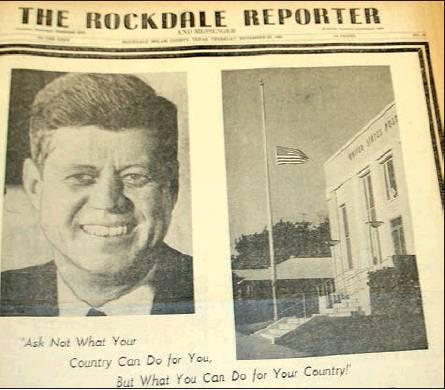
Everyone of a certain age can remember where they were 56 years ago last Friday when President John F. Kennedy was assassinated in Dallas.
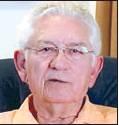
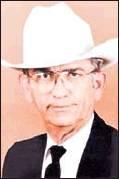
Former Milam County State Trooper Milton Wright certainly has no trouble remembering.
As a 25-year-old trooper, and new father, he was in the fifth car in JFK’s motorcade and only three cars back from the president. Wright heard the assassin’s shots and helped lift the mortally wounded Kennedy from a blood-soaked limousine onto a gurney at Parkland Hospital.
In 2019, just as it was in 1963, Nov. 22 fell on a Friday. As the somber anniversary approached, Wright—who retired in 2002 after a 52-year career as a peace officer—visited with The Reporter about that historic, sad day.
EYEWITNESS—Kennedy, and wife Jackie, were in the motorcade’s second car, along with Texas Gov. John Connally and his wife, Nellie.
Wright was less than a football field’s length behind. His assignment was to chauffeur Dallas Mayor Earle Cabell, and wife Elizabeth Cabell, and Congressman Ray Roberts. Wright had just turned onto Elm Street in soon-to-be infamous Dealey Plaza when he heard a shot ring out.
“I knew it was a shot,” he said. “No doubt about it.” (Others would also immediately recognize the sound as a shot, including Gov. Connally). “Then another and another.”
Everything happened at once.
“Mayor Cabell threw his wife onto the car’s floorboard and hurled himself on top of her,” Wright said. “I looked up and there was a motorcycle policeman right in front of me. The bike was down on the street and he was pointing toward the Texas State School Book Depository.”
Wright looked in that direction. “I looked at the first couple of floors and there were people hanging out the windows watching the parade.
Then I looked up toward the top floor but I didn’t see the shooter.”
Wright is confident the only shots fired in Dealey Plaza that day were by Lee Harvey Oswald. “I can understand the confusion about where they came from,” he said. “That first shot echoed all over the place and then they were all echoing at once.”
PARKLAND—Wright, immediately sped forward toward the president’s limo to see if he could help.
“I got up there pretty quickly,” he said. “I was in a specially modified Mercury Comet and that thing could really go. I actually got up to the president’s car before the first group of help arrived. It was pretty much just me and the Secret Service guys.”
He did not witness Jackie Kennedy crawling onto the “top-down” convertible limo’s trunk in a desperate effort to try and obtain help.
An improvised “emergency motorcade” took off toward Parkland Hospital.
“I was the last car to get through before they closed the road,” Wright said.
The next few minutes were filled with confusion. Kennedy’s limo driver didn’t know where Parkland was and a Dallas motorcycle police man sped alongside to give him directions.
It was 1963 and there were no cell phones. “The people at Parkland were not real sure what was going on,” Wright said. The young trooper was pressed into service immediately after the vehicles arrived.
“There were not that many people around,” he recalled. “I know the Secret Service was worried there might be a general insurrection, that more government officials might be targeted, and several of them went to protect Vice-President Johnson.”
(Johnson had been riding in a car in between Kennedy-Connally and Wright. He had arrived in Dallas that day as vice-president. He would leave it as president.)
“So I helped get the president out of the limo and onto a gurney there in the hospital’s sally port,” Wright said.
Did he know how badly Kennedy was wounded?
“Oh yes. That was obvious,” Wright said. “It looked like half his head was gone. I thought he was already dead, and he might have been. This just wasn’t something anyone was going to survive.”
BIZARRE—There were a couple of moments, both involving Connally, which might almost have been comical under less apocalyptic circumstances.
“Before the governor was taken inside the hospital, he looked at us like this was some Grade B movie and said: ‘Well, they got me boys’.” Wright remembered. “Of course I’m sure he was in shock.”
Wright was given the assignment to guard Connally’s hospital room.
“They had put up three photos on the wall and I was told to admit only those three people to his room,” Wright said. “Well, I didn’t know the governor’s family that well and John Connally Junior’s picture was not on that wall.”
John Connally Jr. was, at the time, a 17-year-old high school student in Austin. He initially heard that his father had been shot in the head, like the president. The younger Connally was rushed to Parkland by plane later that afternoon.
“I was actually escorting him out when people started waving their hands at me going ‘no, no, that’s the governor’s son’,” Wright recalled.
About 30 minutes later, Wright was relieved of duty at Connally’s hospital room. “I’ll always believe it was because of that incident,” he said, able to laugh about it now, 56 years later.
PART OF HISTORY—
Wright, who was certainly part of that historic day, was never interviewed by the Warren Commission. But, two or three days later, he went to the Dallas FBI office and gave a brief statement on what he observed.
He believes the commission got it right, concluding that Lee Harvey Oswald, acting alone, shot the president from the sixth floor of the School Book Depository where Oswald worked.
Wright, who was possibly the closest person to the Depository with professional firearms experience, has never wavered from reporting he heard three shots, all from the same direction.
A number of conspiracy theorists of the past half century have insisted more than three shots were fired, coming from different directions.
“If there had been another shot from the other side I would have known,” Wright said.
Many of those “multiple gunmen” theories contradict each other.
That sixth floor site is now a museum and Wright’s voice is one you will hear at one of the displays.
“The museum curator called me many years after the assassination and got me to do that,” he recalled.
ALL THE BASES—Just three years after the assassination, Wright moved to Milam County and began a 15-year career as a state trooper here.
He left Milam in 1981 but not before having a locally famous secondary “career” as a musician.
Wright was a member of the Rhein Steins band, which featured German and Czech music, and also with other bands, specializing in piano and accordion.
After 19 years in the DPS, Wright moved on to become a Texas Ranger, staying with that elite force for 15 years.
He won four terms as sheriff of Fort Bend County, serving during a period which saw that Houston-area location become the fastest growing county in the nation.
At one time he oversaw 50 deputies, 50 dispatchers and had a department budget of $55-million.
He retired in 2003.
But Wright hasn’t retired from music. He’s got an extensive collection of keyboards and accordions.
“I still dabble in it,” he laughed. “If I’m not on the golf course, I’m probably making music.”
Wright remains proud of his law enforcement work and maintains he has pretty much “touched all the bases” in his long career.”
“I’ve been a state trooper, a Texas Rancher and a big-county sheriff,” he said. “And now, I’m a marshal on a golf course!”
- Log in or Subscribe to post comments.