

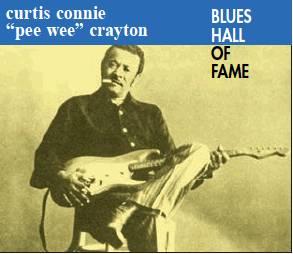
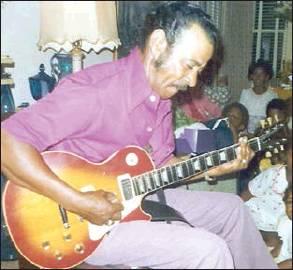
After years of living in relative obscurity, West Coast Blues guitarist Curtis Connie “Pee Wee” Crayton was inducted into the Blues Hall of Fame in May along with the Queen of Soul, Aretha Franklin, Count Basie, Ida Cox, Booker T and the MGs and eight other music industry professionals.
Crayton was born to Samuel C. Crayton and Octavia “Tave” Crayton, Dec. 18, 1914, on their 50-acre farm in Bow Den, the eastern end of the Liberty Hill Community near Rockdale.
The Blues Foundation honored the inductees in its 40th class with a special ceremony at the Halloran Centre for Performing Arts and Education in Memphis, Tennessee.
Crayton’s thick chords, jazzy single-note picking and chord-bending sound left an indelible mark in the history of electric blues guitar playing considering he’d only played guitar for four years when he recorded the chart topper.
“He earned the distinction of playing on two Number 1 hits in 1948 by providing the guitar work on Ivory Joe Hunter’s “Pretty Mama Blues,” which peaked just six weeks before “Blues After Hours,” according to the Blues Hall of Fame. “Cray-ton recorded his chart-topper for the Modern label in Los Angeles in addition to two other Billboard hits, “Texas Hop” and a vocal ballad, “I Love You So.”
Although he considered his skills rudimentary at that point, he was hailed as a guitar phenom in publicity for national tours that followed, and guitar manufacturer Leo Fender presented him with a prototype Stratocaster and amp.
His Fender guitar is on display at the museum in Memphis.
BLUES AFTER HOURS–In 1948, a record company distributor, Tony Vallerio caught Crayton’s show at the Swing Club in San Francisco and introduced him to Modern Records’ owner Jules Bihan.
“When I recorded ‘Blues After Hours,’ we couldn’t find a tenor saxophone player. So it was done in four pieces: A bass, drums, piano, and guitar. And I didn’t know what I was going to play. And when I played it, it was just like the record. Jules said, ‘That’s a hit right there.’ He said, ‘Let’s name it ‘Blues After Hours.’ I said, ‘Oh, whatever,’ So I forgot about it’,” Crayton told Living Blues magazine.
Three months later the record was a hit across the country. It was all over the radio waves. Although Cray-ton was popular at the time, he received no monetary benefits from the hit.
“I didn’t even have it copyrighted. So that’s when he copyrighted the thing and put his name on it. Pee Wee Crayton and Taub. He took the song,” Crayton said in the interview. “I was the number one attraction in the country for three years.
“I went across the country with a band that couldn’t play five songs all the way through. Only thing I could play was the tunes I recorded, and couldn’t play them too good. But I mean whenever I’d go, I’d draw a lot of people because really I was… I was a good looking man at the time. And very popular you know, with the women any way. So wherever women go, the men gonna be there,” he said.
Crayton admitted he neglected the business side of his career.
“I was too busy chasing girls, and things, I didn’t know nothing about taking care of no business,” he said in Living Blues.
NICKNAME–There are two stories how Crayton got his nickname. One has Cray-ton cousins recalling that Crayton was the smallest of the five boys so everyone called Curtis “Pee Wee.” There were 10 children total in the Crayton family.
The second is one Crayton told himself. He said he got his nickname from his father, who was watching a guitar player at a Saturday night supper. He was so good that Samuel C. said he was going to name his next son after the guitarist. Crayton told Living Blues magazine.
Crayton’s father died when he was 18 months old. Jean Brazzell, Crayton’s older sister said in 2004 that their father died of pneumonia.
“What I’ve been told is that my father took sick in Rockdale, and there were only one or two doctors at the time,” she said. “They had done all they could for him and they told my mother to move to Austin where more doctors could help him.”
Crayton’s oldest brother Plato E. Crayton brought his mother and two younger siblings to Austin. Pee Wee and Jean lived out their childhood years in the music capital’s east side. Crayton was a fun loving joker.
Brazzell said: “Everybody loved Pee Wee. They were forever giving him things to play with. He was a sweet boy. He went from a ukulele to a guitar.”
That’s how the entire family remembered the youngest Crayton. Brazzell said her brother loved donkeys and horses and was always riding them all over town.
They both attended Olive Elementary, Kealing Junior High and Anderson High School in Austin.
WEST COAST BLUES–
When the World War II broke out in 1941, Crayton moved to the Bay Area to work in the defense industry along with 45,000 plus African Americans, which transformed the region’s racial makeup.
In a Living Blues interview Crayton said, “…my wife, and I, we moved up to Oakland. And I started to work at Marc Island Navy Yards. That’s in Vallejo, and I drove up to work every morning. It was, oh, I guess 20, 25 miles. And during this time I started listening to different records then. So I heard Charlie Christian play. And I liked that, you know I bought a bunch of his records.”
Crayton was part of the rural south and southwestern migration to the west coast that forced desegregation. President Franklin Roosevelt signed an executive order that banned discrimination in the job sector, which more than tripled the population of the black community in the Bay area.
Critics said that the blues that was created in California in the 40s and 50s was an extension and an urbanization of the Texas blues.
Crayton started playing guitar professionally in the San Francisco Bay area in the ‘40s, along with other blues legends. It was here that he met T-Bone Walker.
GUITAR LESSONS–“I was crazy about guitar but I couldn’t play it,” Crayton said. “I found out T-Bone Walker was in Oakland, at a place called the Swing Club. I knew Slim Jenkins there, so down I went, and T-Bone was at the bar. I asked, ‘Would you help me sometime?’
“He didn’t throw me out on my ear. ‘If you can catch me when I’m not busy,’ he told me, ‘I’ll do what I can.’ …Well it was terrible. I tried and tried, but I couldn’t play in time. ‘No man. You’re not playing in time,’ he said, kind of fierce. ‘Music is played in time. You have to feel it.’ T-Bone plays bass, and piano too, so he said, ‘Come on. You got a piano at home?’ and with that we went back. First off, T-Bone taught me how to tune the guitar to where I could get the blues sound,” Crayton said.
Crayton was 33 when he bought a $400 guitar and still couldn’t play in time.
“And people was hoorawing me about this guitar. They’d tell me to put that ‘starvation box’ down and get a job,” Crayton said.
He took guitar lessons from John Collins, who was playing with Nat King Cole.
After a year of practice, Crayton started playing guitar for a four-piece blues band and played up and down the California coast and recorded with several record labels.
Crayton died in Los Angeles June 25, 1985, after a triumphant return to his home town of Austin to play at Antone’s. In his honor, a host of the area’s best guitar slingers later gathered to stage the “Pee Wee Crayton Battle of the Blues Guitar.”
- Log in or Subscribe to post comments.