

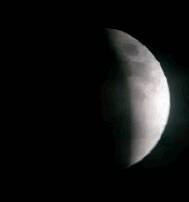
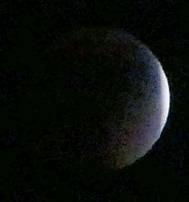
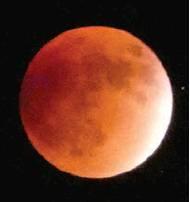
There’s a sky spectacular for Rockdale residents, and the rest of the Western Hemisphere, on tap Sunday night.
If the weather cooperates, that is.
A total eclipse of the moon will offer just over an hour of totality in an event that has a lot going for it from our neck of the solar system.
It’s not terribly late—totality begins at 10:41 p.m.— the moon is about as big as it ever gets and it will be almost overhead in the sky.
Lunar eclipses are, of course, when the moon passes through the earth’s shadow. Not every one is total and not every one can be seen from Texas.
The partial phase begins at 9:34 p.m. The earth’s shadow takes a bigger and bigger “bite” from the moon until 10:41 when it becomes total.
Totality lasts from 10:41 until 11:42 awhen there will be a dark reddish moon hanging like a ghost among the stars.
Probably. The actual coloration is determined by a number of factors and every eclipse is a bit different.
Totality ends at 11:42 and the partial phase is over at 12:51 a.m.
However the second half of a lunar eclipse is just the first half in reverse.
Sunday’s eclipse is special in another way. Since the moon’s orbit is not a perfect circle, it’s alternately a little closer, and a little further away, each month.
This eclipse occurs only 13 hours before the moon reaches its closest point to the earth in January.
In recent years, spurred by ever-present social media, full moons occurring near that closest point have been called “super-moons” by some.
For the record, the average size of the full moon is 31 seconds of arc—that’s less than your thumb held at arm’s length—and the size of the full (eclipsed) moon Sunday night will be 33.3 seconds of arc.
That’s really not much different.
While the spectacle can be observed with the naked eye, binoculars will enhance the experience.—M.B.
- Log in or Subscribe to post comments.