


It’s there. And it’s real.
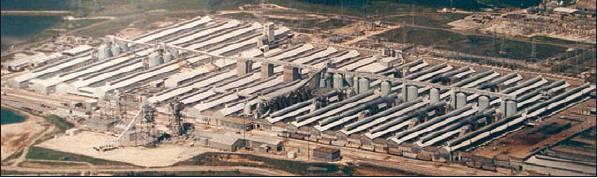
Bitmain, that is. Or to be more correct the company’s “Rockdale Mining Farm” site has transformed the old potrooms at Alcoa’s Rockdale Operations.
On Friday, seven Milam County residents, representing county government, economic development and the press, were taken on a tour of work Bitmain has done, so far, as it prepares to begin actual bitcoin mining this spring or summer.
Photos were strictly prohibited so descriptions will have to suffice. What the group saw were row upon row of metal “ant boxes” stretching the length of the airplane hangar-sized rooms which once roared with industrial noise, cranes, tappers and potliners—men and women whose job it was to coax molten aluminum from ore.
In a few months it will be a different kind of roar, or hum, as 168,000 linked “antminer” computers coax the elusive cryptocurrency “bitcoin” from a set of complex mathematical equations in cyberspace.
NEXT STEP—When mining starts in a few months, there will be about 30 persons involved, according to Kelly Ballew, site facility manager for Bitmain and a Rockdale native.
He said about 12 persons have already been hired. “We are really impressed with the people we have hired,” Ballew said. “They have caught on really quick.”
That’s a far cry from the 400 or so jobs forecast when Bitmain’s plans were announced last summer. But it’s viewed as only the start. Bit-main is forecast to be at the site “for good.”
“We’ve spent around $20-million here,” Ballew said.
“We will also do repairs here, he said. “And there will be some technical jobs.”
He noted the company is anticipating growth once mining begins.
For now, the next step is to link up the ant-miners with a power supply, a task that’s estimated to last a couple of months, Ballew said.
Bitmain is using six potlines. That’s the number which were active when Alcoa announced the first of two three-potline shutdowns in June, 2008. A final three-potline shutdown followed in September.
Ballew said each potline will require about 50 megawatts of power. One of the prime reasons for Bitmain to locate at the former smelter was the availability of power infrastructure to provide the massive amounts of electricity needed.
“Yes, the power is available for us,” Ballew said.
TECHNOLOGY—
There’s always room for optimism in the quick changes today’s, and tomorrow’s, technology can bring.
Ballew pointed out the initial antminers beig installed at Rockdale were S-15 machines. The newest ones are more powerful S-17’s and there are presumably even higher number S’s in the works.
Why are the computers called “antminers?” That’s a topic of some debate but one educated guess is that the machines mimic the social construction of ants in a hive. That is, there are a lot of them, all are programmed to do a single thing and do it well.
Ballew said there have already been tests of the mining system that went spectacularly well. “There were hardly any failures,” he said.
The antminer modules, with their ever present logos (see graphic page 1A), are air cooled. Workers have removed the sides of potrooms to assist with the cooling effort.
The human miners will be housed in an on-site control room.
HIGH TECH—Ballew said he has no inside knowledge of the anticipation for one or more solar farms to set up in Milam County.
“That would be just great for us,” he said. “We can use every bit of power they can produce.”
The tour group got to visit, and go inside, an antbox which had not yet received its antminers. It contained rows of thin metal shelves which already contained what looked like the power cords everyone has on their work, and home, computers.
“That’s essentially what they are,” Ballew said. “But these are much higher rated for the amount of power going through them.”
The Bitmain crew members are presently working out of an office at the entrance to the former Alcoa mines.
Some of the old Alcoa trappings are still there, including signing-in and signing-out at guard shacks to access the interior of what was for over 60 years the economic lifeblood of Milam County and is now coming to life again.
- Log in or Subscribe to post comments.