


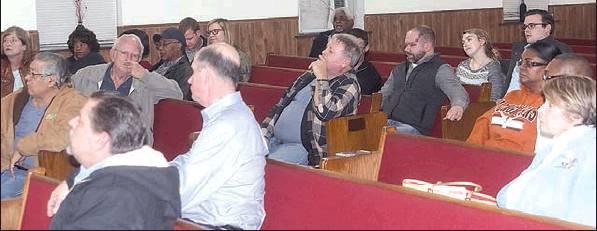
A curious and engaged crowd of about 50 appeared ready to buckle down and face the painful task ahead regarding their water rates at the first of four town hall meetings Thursday evening at New Hope Baptist Church.
Consensus was that the time has finally arrived to address a half-century of red water and system failure problems, even if that means more than doubling residential water bills.
And that’s what it means. Preliminary estimates show an average monthly water and sewer—not including trash pickup—bill going from the current $73.84 to $106.69 this year to $195.98 by 2023.
But, as town hall participants learned, there are a number of wild cards which could still result in a more positive impact on water and sewer bills, chief among them the possibility of purchasing already treated water from area water supply entities.
FEDS, DELAY—There are also negative factors, chief among them the growing price tag of the overhaul.
City Manager Chris Whittaker said in addition to the $48.6-million estimated price tag to revamp the water system, the project now also includes $15-million for sewer system repairs, an estimate which likely will grow by $2.5-million or more due to additional state and federal citations.
That brings the total—water plus sewer plus new problems—to over $63-million.
Whittaker noted the city has been cited by state (Texas Commission on Environmental Quality) and federal (Environmental Protection Agency) agencies for wastewater violations, a situation which must be addressed.
According to the EPA, the sewer plant is out of compliance in categories E. Coli, Total Suspended Solids (TSS), Ammonia Nitrogen and Carbonaceous Biochemical Oxygen Demand.
“If we don’t show them (agencies) we’re doing something, they’re going to start slapping us with fines,” he said.
And, even though the initial $10-million phase of the project, along with the first rate hikes, is scheduled to come before the city council on Monday, officials estimate it will still be more than three years before any work can be done.
That’s because a firm engineering, and repayment, plan must be compiled and approved before work can be started on the massive task.
PIPES, TREATMENT—
Whittaker and consultants Matthew Garrett (New Gen Strategies & Solutions), Bob Lane and Bob Fisher (KSA Engineers) outlined project details.
Whittaker said the project is two-fold, replacing 26 miles of cast iron pipe—“tubercular” with iron and manganese sediment, cause of the infamous red water—and five miles of asbestos cement pipe.
Whittaker noted much of the iron pipe is over 100 years old and the asbestos-cement pipe has become “soft over time.”
He said lines dating from the 1970s and later, mostly PVC (plastic) in the north and west portions of Rock-dale—but including more recent projects downtown and one currently underway on Rice Street—would not be replaced.
Plans also call for replacing the 84-year-old Mill Street water treatment plant and renovating the Texas Street treatment plant.
Whittaker noted neither of those facilities was designed to treat red water culprits iron and manganese.
WILD CARDS—The much quoted increases—from $73.84 to $106.69 to $195.98—were estimates by Garrett who noted they could be interpreted as “worst cases,” that design and other factors could change them, including growth of the city with more customers spreading out the fee burden.
(Those numbers are based on an average monthly usage of 6,000 gallons water and 4,000 gallons sewer with a 3/4-inch meter).
The real wild card is a feasibility study, currently underway, on ramifications of purchasing already treated water from Southwest Milam Water Supply.
“That could save millions of dollars in not having to build a new treatment plant,” Whittaker said. “But, on the other hand, we would be at the mercy of water supply rates we would have no control over.”
And the question of demand will be another key. “We would need to know if they could handle the amount of water we would need to purchase,” he said
That study will be presented to the city council.
Another possibility is buying from Blue Water, the entity involved in transporting water to San Antonio.
“That’s about 10 miles away,” Whittaker said. “A question there would be the cost of creating a line to link that system with the city’s.”
SHARING THE COST—
The burden of drastically increased water rates, and its effect on customers was brought up by Mayor John King.
“That’s my main concern,” he said. “What about those people on fixed incomes, those who just can’t afford that extra $100 a month in their budgets?”
Garrett said municipalities have fine tuned rates in various ways including income-based and senior citizen relief, but any decision of that kind will be up to the council.
He noted the rate structure being proposed calls for those who use the most water to be affected most by the increased rates.
Also presented was a set of numbers for “low usage” customers which showed a lower increase in monthly bills.
The final sewer numbers will depend on several factors, it was noted, including the additional extra money needed to satisfy the state and federal agencies and the eventual design of the wastewater project.
However, increases in sewer bills are a certainty.
COUNCIL VOTES—
The initial council vote on the first $10-million of the project, which will include design and engineering phases for the entire task and the first-year water rate increases—is to be presented to the city council for a first-reading vote on Monday.
Second reading will be February. Whittaker said funds could be on hand by April.
But, and it’s a big one, even then it will probably be another three years before work on the mammoth project gets underway.
Until then, the only option is the usual “patch and fix.” Whittaker had previously noted approximately 1,200 such breaks and patches were needed in the most recent three-year period.
- Log in or Subscribe to post comments.