

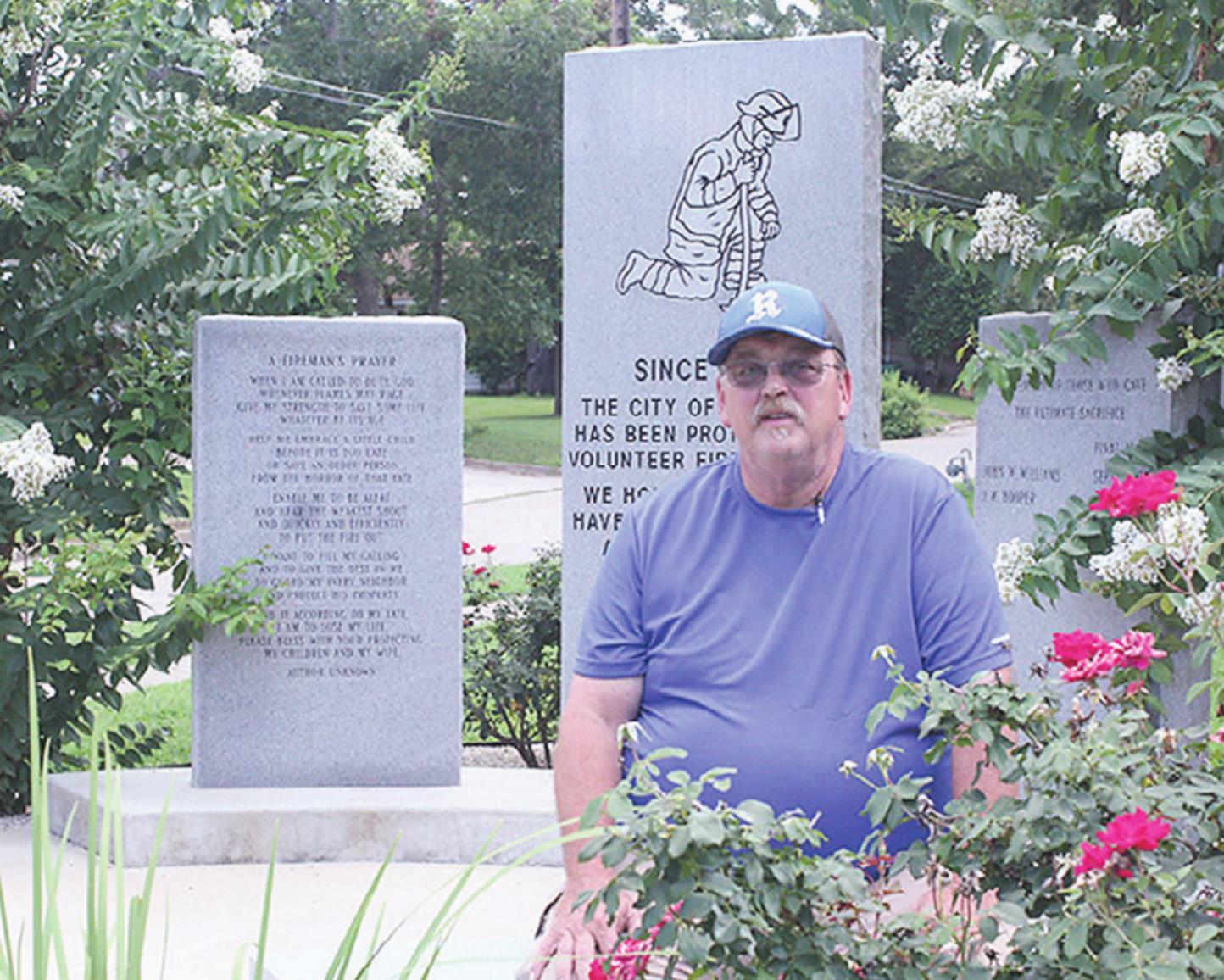
Herbie Vaughan’s career in firefighting and law enforcement began like so many others’ careers—he needed a job.
He was fairly fresh out of Aldine High School in Houston and wanted to go to work.
His first choice was law enforcement.
“I wanted to become a police officer,” he said. “Police said I looked too young.”
Fortunately the firefighting recruitment center was next door to the police recruitment office, he said.
“I walked out that door and then went next door,” he said. “They didn’t care how young I looked.”
He then spent 28 years working for the Houston Fire Department.
“I drove a fire truck for a while, then I made captain,” he said. “I trained firefighters and made sure the equipment was ready to go. I really enjoyed it.”
While he was with the HFD, he and his wife moved to Rockdale and signed up for the town’s volunteer firefighting force.
“Tom Fisher stopped by my house and asked if I was the Houston firefighter who had just moved here and asked if I would be interested in joining Rockdale,” Vaughan said.
He answered yes. That was in 1989 and he became the RVFD chief in April after Ward Roddam announced his retirement.
In his time with the Houston department he was on an ambulance as a paramedic, too.
“I made all the shootings, stabbings and accidents,” he said.
But he also still harbored the desire to be in the law enforcement field.
“I actually thought I would get into law enforcement through the arson divsion, but they (HFD) kept eliminating positions,” he said.
In 2000, while still with the HFD, he went to the police academy at Texas A&M.
“When I got out of the police academy, I reserved in Thorndale and got an offer for a paid position as a sergeant in Thorndale in 2003,” he said.
Then in 2004, Thorndale Police Chief Cecil Hamm had to resign for health reasons, Vaughan said.
“They offered me the chief of police job and I was there 10 months,” he said.
He ran for the Milam County Precinct 3 constable position and held that job for eight years.
Vaughan was recognized for his diligence in ticketing speeders in his precinct.
In a July 2005 Rockdale Reporter article, Editor Mike Brown wrote: Vaughan became constable of Milam County’s southeast quadrant Jan. 1 of this year and in just six months his department has already written more traffic tickets and generated more revenue for the precinct than happened in all of 2004.
A lot more. According to statistics provided by Justice of the Peace Twila Harris, Vaughan’s department has issued 1,149 traffic tickets since Jan. 1. That’s already 160 percent of the 708 issued in all of 2004.
As a result, revenue collected through the Precinct 3 J-P office is also already over the 12-month total for 2004. Harris’ figures show $133,607.75 collected through June, already 124 percent of the $107,112.25 collected in all of 2004.
“Probably 95 percent of that revenue is due to traffic cases,” Harris said.
“When I campaigned for this job I went door to door all through Precinct 3 and asked them what they expected and what they wanted me to do,” he said. “I heard the same thing, again and again, ‘we’ve got to do something to slow down traffic on the highway’.”
So that is what Vaughan did, he said.
Vaughan also works with dogs in both drug searches and patrols in search of suspects.
He and his dogs have been called on many times such as the time in 2007 when one of his dogs sniffed out about $8,000 worth of marijuana after a traffic stop.
In addition to his role as fire chief, he is also the fire marshal for Rockdale. The fire marshal role involves inspections of buildings for fire code violations.
He, along with his assistants—James Elvis McQuinn, first assistant; Michael Stewart, second assistant; and John Stewart, third assistant—are always looking for more volunteers for the force.
Interested individuals can drop by the station on the first and third Mondays when the firefighters meet and check out the program, he said.
“There is an application process through City Hall and a background check,” he said.
Once that is okayed, recruits are placed on a 180-day probation for training.
“You need quite a bit of training before being sent into a burning building,” he said. “You don’t send people who don’t know what they are doing into a burning building.”
- Log in or Subscribe to post comments.