

Body
Editor’s note: This is the 41st annual Black History Month series by former Rockdale resident Susie Sansom-Piper to appear in The Reporter.
By SUSIE SANSOM-PIPER Reporter contributor
As the people of the United States watched World War I ignite across Europe, African-American citizens still sought to win the opportunity to win the respect of their white neighbors.
Many black men were willing to serve the nations military.
When it came to the draft, however, there was a reversal in usual discriminatory policy.
Draft boards were comprised entirely of white men. Although there were no specific segregation provisions outlined in the draft legislation, blacks were told to tear off the corner of their registration cards so they could be identified and inducted separately into the service.
Also, black men who owned their own farms and their family members were often drafted before single white men.
Blacks could not serve in the Marines and could only serve in limited and menial positions in the Navy and Coast Guard. (The preceding paragraphs from “Military History Online”).
The bombing of Pearl Harbor on Dec. 7, 1941 changed many ideas in military service.
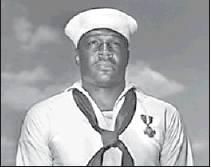
Dorie Miller was on board the U.S.S. Virginia serving as a cook, when it was attacked by Japanese planes in Pearl Harbor.
He manned an unattended anti-aircraft gun. Miller had no training, but he was able to shoot down at least one of the attacking aircraft, before he ran out of ammunition.
He was a native of Waco. Two Rockdalians volunteered for service.
Marion T. Benson was a sailor on the U.S.S. Arizona, and Harry Wayne Jones was a soldier who served time in the Eastern Theater of war.
After each returned back to their native home of Rockdale, they changed residences, Benson to Midland, where he set up a barber shop, and Jones to Chicago, where he pursued the clothing business.
They are buried in these cities.
Gentry Lee Powell, Aycock High school’s fi rst coach, was drafted into the armed services during this time span. When he completed his time in the armed services, he returned to this area.
He was then hired as Athletic coach for the Bartlett Colored High School, and remained there until the integration years, or until his death in the late sixties.
He is buried in Navasota.
- Log in or Subscribe to post comments.